HOME ENERGY STORAGE
Many homeowners believe that a home battery backup system requires solar panels. In fact, a home battery can store electricity from the utility grid and provide backup power during an outage.
This makes battery storage an option for households that want emergency electricity without installing solar panels.
But how does it work, what are its advantages, and can solar panels be added later?
1. How Does a Home Battery Work Without Solar?
A home battery backup system without solar typically uses three main components: a rechargeable battery, a compatible inverter/charger, and suitable electrical switching and protection equipment.
During normal operation, electricity from the utility grid charges the battery through the charging system.
When a power outage occurs, a properly configured backup system can supply stored energy to designated household circuits.
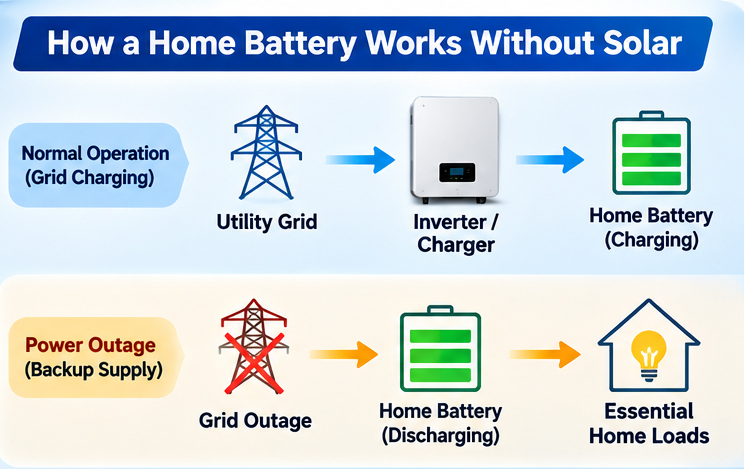
The inverter converts stored DC electricity into AC power for household appliances. Depending on the system, backup operation may be automatic or require a designated transfer arrangement.
Without solar panels, the battery cannot recharge from sunlight during an extended grid outage. Backup duration is therefore limited by the available stored energy and connected loads.
2. Why Choose Battery Backup Without Solar?
Even without solar panels, a home battery can offer several advantages.
- Emergency backup power: Supports selected essential appliances, such as lighting, refrigerators and internet equipment, within the system's power and energy limits.
- Time-of-use electricity management: Where supported, the battery can charge during lower-cost periods and discharge during higher-cost periods.
- Quiet operation: Unlike fuel-powered generators, battery systems operate without an engine or on-site fuel combustion.
- Future solar expansion: Some battery systems can be integrated with solar equipment later, provided the necessary compatibility and installation requirements are met.
Whether these benefits justify the investment depends on local electricity tariffs, outage frequency, system cost and operating requirements.
3. Home Battery Without Solar vs. With Solar
Both systems store electricity for later use. The main difference is how that electricity is supplied.
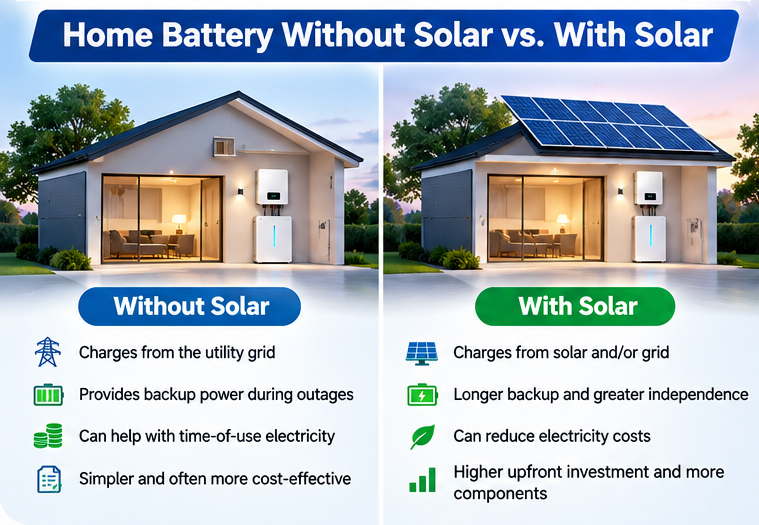
| Feature | Without Solar | With Solar |
|---|---|---|
| Charging source | Utility grid | Solar and/or grid |
| Backup during outage | Previously stored energy | Stored energy, with possible solar replenishment |
| Recharging during an outage | Generally unavailable without another source | Possible with suitable backup-capable equipment |
| Installation complexity | Often simpler | Typically more components |
| Energy independence | Limited by grid charging | Potentially greater |
| Future expansion | Solar may be added if supported | Solar already integrated |
For households mainly concerned about short-term power outages, a grid-charged battery may be sufficient.
For longer outages, a properly designed solar-plus-storage system can offer additional charging opportunities when sunlight is available.
4. Can You Add Solar Panels Later?
Yes, but only if the equipment and system architecture support future solar integration.
Before purchasing a battery system, consider:
- Whether the inverter supports solar integration or compatible external charging equipment.
- Whether the battery and inverter communication requirements are compatible.
- Whether additional battery capacity can be supported.
- Whether local permits, utility approvals or equipment certification requirements apply.
Adding solar later may require new equipment or modifications. It should not be assumed that every existing battery backup system can accept solar panels directly.
5. How to Choose the Right Home Battery Backup
Choosing a home battery starts with understanding which appliances need backup power and for how long.
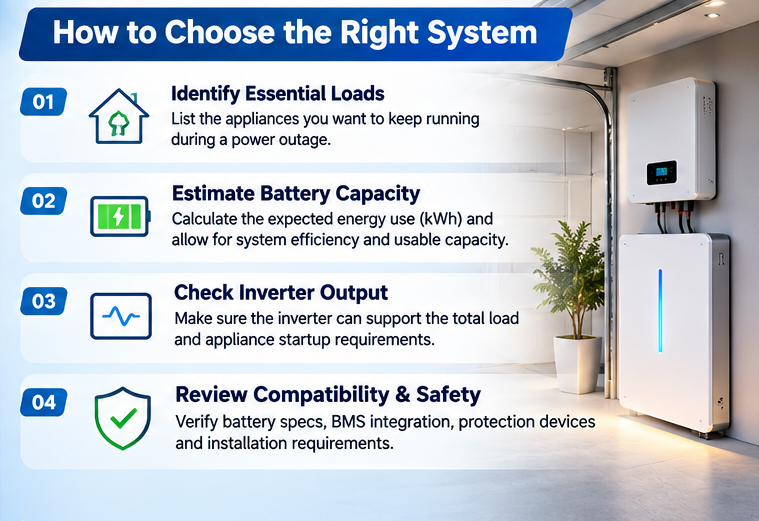
Step 1: Identify essential loads. List the appliances and circuits that must remain powered during an outage.
Step 2: Estimate battery capacity. Calculate the expected energy consumption in kilowatt-hours (kWh), allowing for conversion losses and the battery's usable capacity.
Step 3: Check inverter output. Confirm that the inverter can support the combined operating power and relevant appliance startup demands.
Step 4: Review compatibility and safety. Verify battery specifications, BMS integration, protective equipment, installation requirements and applicable product documentation.
A qualified installer or system integrator should evaluate the final configuration.
Frequently Asked Questions
Can a home battery power an entire house without solar?
Yes, if the battery capacity, inverter output and electrical installation are designed for the home's loads. Many installations instead prioritize essential circuits to reduce the required system size.
How long can a home battery last during an outage?
A basic estimate is:
Actual runtime will vary with load changes, inverter efficiency and system operating limits.
Is a home battery better than a generator?
A battery provides quiet backup without on-site fuel combustion, while a generator may provide longer operation when sufficient fuel is available. The better choice depends on backup duration, power requirements, maintenance and budget.
Explore Home Energy Storage Solutions
A home battery backup system can provide useful emergency power even without solar panels. The key is selecting compatible components and designing the system around actual household energy requirements.
Universal Through supplies LiFePO4 battery cells, inverters and energy storage components for residential storage and OEM/ODM projects.
Contact Our Team to discuss your energy storage requirements.
Post time: Nov-06-2026